Tony Danza–David Cohn relationship
I'd Like to Apologize to Every Teacher I Ever HadThe Tony Danza–David Cohn relationship is the book’s central teaching partnership: a formal supervisor–novice arrangement that becomes a bond of candid advice, mutual protection, and earned independence. Cohn helps Danza turn classroom failure into professional learning, while Danza’s year of teaching gradually changes the terms of their relationship—from an expert’s close guidance to a colleague’s recognition that his pupil can carry on without him.
Identity and Supervisory Arrangement
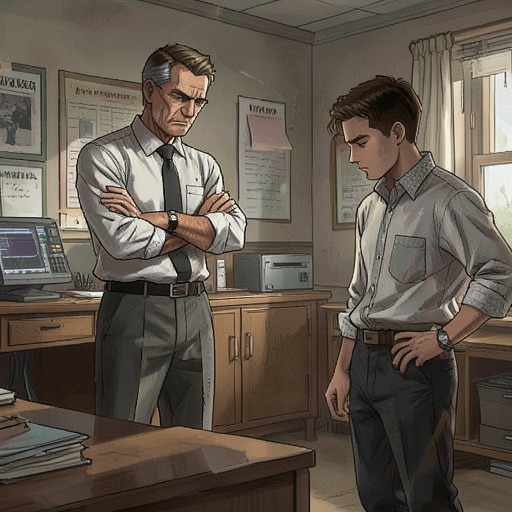
Cohn enters the story as Danza’s supervisor at Northeast High School, a thin, cerebral young teacher whom Danza describes as young enough to be his son. The age difference sharpens their unusual position: Danza is an established performer beginning a second career, while Cohn is responsible for assessing his work as a novice teacher. Their arrangement is not to have Cohn rescue Danza in the middle of a lesson. He observes from the back of the classroom, then reviews what happened with him afterward.
That division of responsibility becomes clear after Danza’s first class collapses. When the students have left, Cohn comes forward and puts a consoling hand on Danza’s shoulder. Danza is close to tears and wants to know why Cohn did not step in, but understands that intervention was not the agreed role. Cohn’s job was to watch and then help him examine the lesson. The first encounter thus establishes both the tenderness and the rigor of their partnership: reassurance follows the failure, but it does not erase the work of understanding it.
Cohn makes that work concrete by returning Danza to lesson planning. Danza has spent three days preparing the lesson that went wrong; Cohn explains that a plan must account not only for what the teacher will teach, but for how he will teach it and how he will assess whether students retain it. A lesson needs a goal and three parts: a warm-up, a main activity, and a wrap-up. The postmortem is not simply a verdict on Danza’s performance. It gives him a structure with which to make the next class more purposeful.
Advice That Changes the Classroom
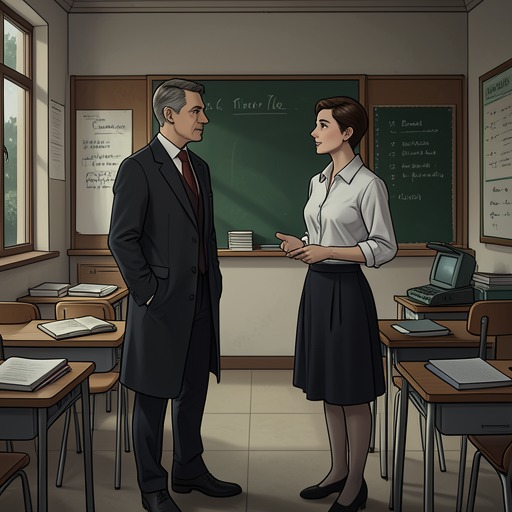
As Danza gains confidence and rapport with students, Cohn’s feedback shifts from the mechanics of planning to the distribution of attention. He likes that Danza has made a connection with the class, but warns that students need more room to speak. His concise recommendation, “Think about doing more with less,” captures a larger pedagogical correction: Danza’s energy and presence are assets, but teaching cannot consist of his voice filling the room.
Cohn spells out the principle behind the advice: “Teaching is different today. Teachers don’t just stand at the board and lecture while the kids take notes. What we’re ultimately teaching them is to teach themselves.” The relationship therefore joins evaluation to a transfer of agency. Cohn is not merely helping Danza deliver information more smoothly; he is asking him to build a class in which students take a more active role in learning. For a novice whose instinct is to carry the room himself, that change requires both restraint and trust in the students.
Their daily reviews also include small, specific moments of shared attention. After Danza shows Cohn an origami piece taken from Eric in class, Cohn calls it impressive, and the two laugh before he offers his advice about doing more with less. The paper object becomes a brief point of connection between the classroom’s unexpected details and the larger professional conversation. Cohn can acknowledge Danza’s engagement with students while still pressing him to make that engagement less centered on himself.
Cohn also serves as a reality check when classroom conflict threatens to draw Danza into a personal reaction. After Danza tells him about a near altercation, Cohn advises, “You can’t let them see that they get to you.” The counsel is practical rather than abstract: Danza must manage his response in the moment instead of allowing provocation to take control of the encounter. Across lesson reviews and difficult interactions, Cohn’s guidance helps Danza distinguish between being emotionally invested in students and being governed by the immediate heat of a situation.
A Partnership Tested by the Production
The show’s production complicates Cohn’s role because classroom observation is also being filmed and shaped as entertainment. Danza recalls that a director once wanted Cohn to conduct a review while walking down a hallway, rather than in the office where he would normally evaluate a new teacher. During the staged walk, the director made gestures out of Danza’s sight urging Cohn to criticize him more aggressively. Cohn refused the cue, saying, “I didn’t sign up to be an actor.”
His refusal draws a clear line between educational supervision and performance for the camera. Cohn later threatens to quit if the production does not stop interfering. Danza confronts Leslie Grief and manages to keep him on the project, but the episode alters how both men understand the conditions of their work. Cohn now knows what they are up against, and Danza becomes more alert to the possibility that a school problem—or a summons from the principal—may have been encouraged for dramatic effect.
The pressure reaches beyond any one manipulated scene. Danza becomes afraid that a student crisis may have been nudged by the production team, making it harder to know whether a troubling situation is simply part of school life or has been intensified for the show. He recognizes that the presence of the crew can obstruct the teaching relationship he is trying to build. Cohn’s resistance matters, then, not only as a defense of his own professional integrity but as a defense of the conditions under which Danza can learn to teach. Their shared work depends on treating students and school problems as real, rather than as material to be heightened for a more dramatic scene.
Mutual Wear and Growing Independence
As the school year advances, the relationship becomes less one-sided. Danza tells Cohn, “I’m wearing him down,” and Cohn replies, “Sounds more like you’ve worn each other down,” adding that it is in a good way. The exchange lets Danza recognize that persistence has a cost and that the effort between teacher and student can change both participants. Danza then realizes that the same description fits his relationship with Cohn. The supervisor who has absorbed his anxiety and repeatedly saved him from himself has also been changed by the year they have spent working together.
Their bond is expressed through practical help as much as formal feedback. Cohn has been present through Danza’s doubts and missteps, but does not mistake support for permanent dependence. When Danza pulls off a difficult class, Cohn throws an arm around his shoulders and tells him, “Mr. Danza, you sure pulled that one out of your ass.” The blunt praise recognizes an achievement without making it sound effortless: Danza has managed to recover and deliver, and Cohn can now celebrate the result rather than only diagnose the failure.
Cohn also explains a feature of the school’s academic routine that differs from Danza’s expectations: Northeast High School has no finals week. Graduating seniors present a multimedia project to a panel of teachers, while lower-class students are generally graded on work completed throughout the quarter; the district does not require final exams, so most teachers do not give them. This conversation shows Cohn still orienting Danza to the institution’s practices, even as their relationship moves toward its close. Mentorship has not meant that Danza instantly knows the school; it has given him a trusted colleague from whom he can learn its particular rules.
Departure and Significance
Cohn’s departure makes the change in their roles explicit. He is moving to a school in Vermont, and the next day will be his last. Danza teases him for not seeing the project through, but Cohn answers, “I never thought I’d live to say this, Mr. Danza. But you don’t need me anymore.” Danza grins and replies, “I never thought you would, either.” The exchange is affectionate because it admits how improbable their starting arrangement seemed: the novice once wanted his supervisor to step in and save him; now the supervisor can leave without doing so.
The ending does not present independence as a rejection of Cohn’s influence. Danza remains grateful for the person who watched his worst early lesson, gave it a framework for review, challenged his teacher-centered habits, and refused to turn supervision into manufactured television conflict. In his acknowledgments, he identifies Cohn as his “coteacher, mentor, and main cheerleader.” That combination preserves the relationship’s full shape: professional instruction, companionship, and encouragement. Cohn’s achievement as a mentor is finally measured not by keeping Danza reliant on him, but by recognizing when Danza can continue teaching without his daily oversight.